
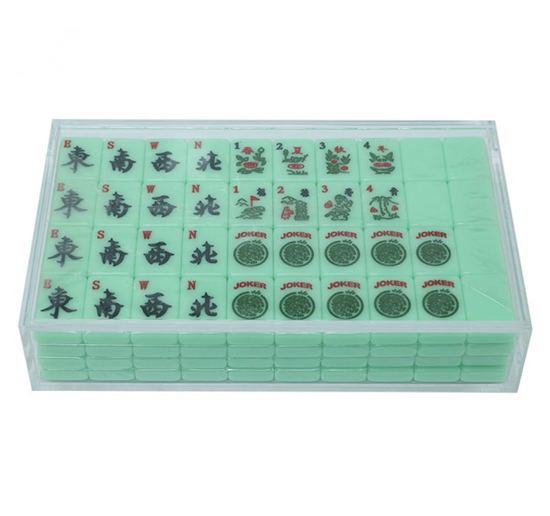
“Please include extra tiles” leaves several decisions open. Does the buyer want unmarked faces, duplicates of particular playing tiles, or a decorative brand tile? Will those pieces go inside every retail set or into a separate stock of replacement parts?
For a custom mahjong order, give each extra tile type its own line in the tile list. Record its purpose, face, back, quantity and packing location. Then reconcile that list with the artwork proof, physical sample and retail contents description. A total tile count alone cannot communicate those decisions.
Separate the purpose from the appearance
Use these distinctions when preparing a brief for a brand collection, boutique assortment or gift program. The labels describe order contents; they do not establish playing rules.
| Extra tile type | What the buyer needs to specify | Assumption to avoid |
|---|---|---|
| Blank-faced tile | An undecorated face, the required back design and the agreed tile construction | “Blank” means both sides are undecorated |
| Duplicate spare | The exact face ID to repeat, its artwork revision and quantity | Any unmarked tile is an identical replacement for any missing face |
| Branded extra | The approved logo or illustration, orientation, back and intended use | A decorative brand tile automatically replaces a playing tile |
| Teaching or reference extra | The specific markings, purpose and quantity, reviewed separately from the playing inventory | It is included merely because it appears in a presentation render |
If a tile is intended to enter play, the buyer should confirm how it fits the intended rules and audience. Keep that decision distinct from whether a supplier can produce the requested artwork. This guide does not prescribe a universal set size or required number of extras.
Define what “blank” means on both sides
A plain face and a plain back are separate instructions. An order could call for an undecorated face with the same patterned back as the rest of the collection, or for a completely undecorated piece. Write the selected arrangement explicitly and show both sides in the proof.
Also identify the required size, thickness, edge appearance, material construction and finish by reference to the approved tile specification. If an extra is intended to match the playing tiles, ask for it to be reviewed alongside those tiles in the sample. Do not assume a later batch will be visually identical without checking it.
Avoid promising that customers can simply write on, print on or otherwise decorate a blank tile themselves. Suitability for a particular marking method needs confirmation for the actual surface and intended use.
Give every extra a traceable line in the tile list
An extra tile needs more than a thumbnail. Include:
- Tile ID and purpose: blank-faced spare, named duplicate, brand extra or another clearly defined use.
- Face reference: the artwork filename and revision, or an explicit instruction that the face has no decoration.
- Back reference: the selected back design and orientation, including any intentional difference from the playing tiles.
- Quantity basis: pieces per retail set, or a separate quantity for the whole order.
- Packing location: the named tray position, an agreed separate compartment or a separately identified spare stock.
- Approval status: the proof and sample reference covering that item, plus unresolved questions.
Use the same IDs in the artwork package and packing list. If a duplicate repeats an existing face, link to that approved face instead of creating an unexplained second artwork file.
Keep retail extras separate from order-level spare stock
A request for “two spares” can mean two pieces in every set or two pieces across the entire shipment. Put the quantity basis beside the number, not in a distant email.
Consider this illustrative brief for a collection called Meadow. These are example instructions, not a recommended configuration or a MahjCustom stock specification:
Each retail set contains the playing inventory listed in tile map MEADOW-R3, plus two blank-faced tiles using back artwork BACK-A-R3 and one decorative brand tile using face BRAND-R2. These three extras are included in the retail set's declared total. Separate replacement stock contains four copies of face DOT-1-R3 for the whole order; those four pieces are excluded from each retail set's contents count and packed separately with the collection and revision identified.
The example makes three boundaries clear: which pieces supplement the playing inventory, which pieces belong in every box, and which pieces are held separately. In an actual order, the playing inventory must itself be a complete face-by-face list, with all quantities reconciled.
Ask for the quotation and packing proposal to reflect the final configuration. Changing extras may change the packing arrangement or quoted scope; confirm the effect before approving the revision.
Check the extras in a complete packed sample
Lay out the physical pieces against the tile list and count by ID. Check the face and back of each extra, rather than counting a stack whose faces are hidden. A correct grand total can still conceal a missing blank and an unintended duplicate.
Next, pack the full agreed contents. Confirm that the extras have a defined place, the lid closes as intended and nothing listed as order-level spare stock has been mistaken for a per-set inclusion. The box insert fit checklist covers the wider packing review.
Compare the approved sample with the box contents card and product listing. Describe decorative or spare pieces clearly so buyers know what they receive. A product photograph should not be the only record of the included quantities.
Before signing off, confirm:
- Every extra tile ID appears in the approved list and relevant proof.
- Face and back treatments match the written instruction.
- Per-set counts and separately packed quantities are independently correct.
- The complete configuration fits the approved packaging.
- Retail copy accurately identifies the included extras.
FAQ
Does a blank tile have to be undecorated on both sides?
No. “Blank” is ambiguous unless the specification defines it. State whether the face alone is undecorated and identify the required back artwork or absence of decoration.
Is a duplicate spare the same as a blank-faced spare?
No. A duplicate repeats a named face; a blank-faced spare has no face decoration. Identify the intended purpose and approved artwork for each instead of using “spare” as the only description.
Can a branded tile replace a playing tile in the order?
Only treat it as a replacement when that change is explicitly agreed in the buyer's tile list and intended playing configuration. Otherwise, identify it as a separate extra and count it accordingly.
Should replacement stock be packed in every retail box?
That depends on the order brief. Distinguish per-set inclusions from stock supplied separately for the whole order, and confirm both quantities and packing locations before approval.
Prepare your tile configuration brief
Start with the custom American mahjong set you want to develop, then add the tile list, extra-piece purposes and proposed packing arrangement to your customization brief. If the quantity basis or role of an extra is unresolved, identify that question when you discuss the project with MahjCustom so it can be settled before sample approval.