
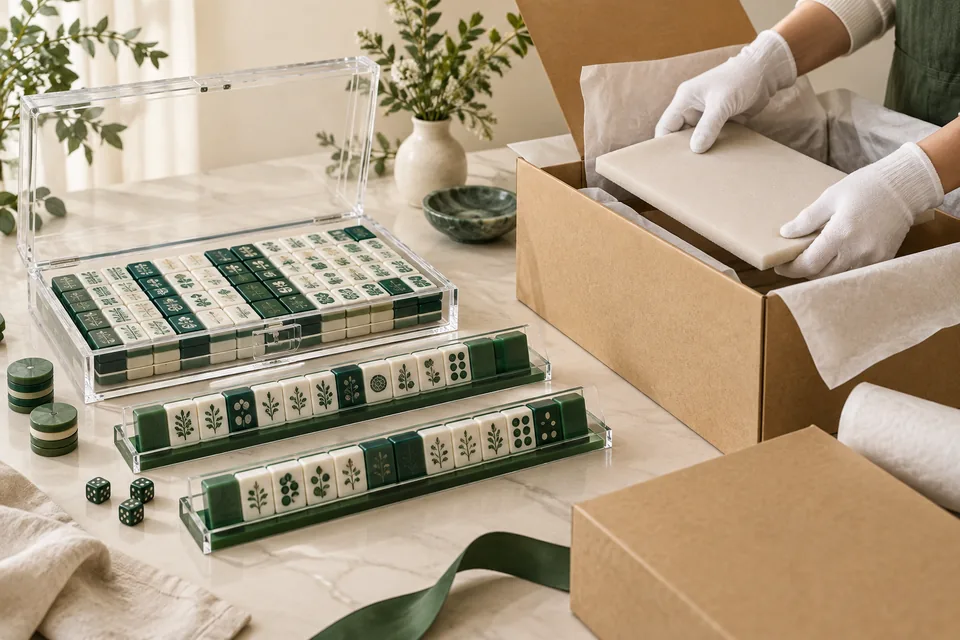
Approve a mahjong box insert by packing, unpacking and repacking the complete proposed set. Check that every item has an assigned position, that users can remove it without forcing it against another component, and that the box closes as intended. Record the exact contents and insert revision used in the review.
A neat photograph of an open box cannot answer all of those questions. This checklist helps brand owners and retail buyers review a physical insert sample before accepting its fit. For choices between bags, presentation boxes and shipping cartons, start with the broader custom mahjong packaging guide.
Prepare the contents before testing the insert
Use the agreed tile list and accessory list to assemble a complete set. Include spare tiles, dice, printed cards, protective sleeves and any other items that will actually go inside this box. Identify anything that ships separately, such as a mat in its own bag, so it is not accidentally included in the insert approval.
Record the full tile dimensions and the versions of the racks and pushers. A shared product name or tile height does not establish that two sets have the same packed dimensions. The tile measurement guide can help you prepare these references.
If the final components are unavailable, label the review as provisional and list the substitutes. A plain tile blank may help assess space, but it cannot establish how the finished decoration behaves against the insert surface. Reserve the relevant checks for representative finished components.
Give every compartment a clear purpose
Ask for a top-view layout that labels each row, compartment and removable layer. Match those labels to the contents list, including the quantity placed in each position. For stacked trays, show the lower layer as well as the visible upper layer.
Agree how tiles are packed: their orientation, grouping and whether they have wrapping or separators. The sample should use that same arrangement. An insert that fits loose components may need another review when the agreed protective wrapping is added.
Before handling the sample, photograph the complete layout and identify the insert and box revisions. These images give the reviewer and supplier a common reference when discussing a tight corner, a loose accessory or a missing space.
Work through the packed-sample checks
Use the table as an inspection worksheet. Record what you observe alongside the agreed requirement; do not mark an entire sample approved because its presentation looks good.
| Check | What to do with the sample | What to record |
|---|---|---|
| Complete contents | Pack every listed item in its assigned position | Count discrepancies, omitted pieces or items without a defined space |
| Tile rows | Load the full row in the specified orientation | Whether the last tile fits without forcing, and where excessive movement is visible |
| Removal access | Remove tiles and accessories using the intended finger recess, ribbon or tray | Difficult access, snagging or pressure against decorated surfaces |
| Accessories | Fit the specified racks, pushers and small parts in their compartments | Contact between components, loose parts and any improvised packing |
| Layer clearance | Fit every tray, card and protective layer before closing | Raised corners, displaced contents or contact with the lid |
| Surface contact | Inspect finished components before and after the agreed handling review | New marks, transferred color, debris or areas that need closer examination |
| Repacking | Return all contents using the proposed packing instructions | Ambiguous positions, awkward steps or a closure that only works with special adjustment |
Agree any dimensional tolerances and acceptance criteria with the supplier for the actual materials and construction. This checklist does not prescribe a universal gap around each tile or a fixed force for removing it.
Check the closed box as carefully as the open layout
Close the fully packed box using its intended closure. Check whether the lid sits in its intended position and whether contents have to be pressed down or rearranged to make it close. For a layered layout, inspect the upper surfaces and corners for contact after reopening.
If a ribbon or finger recess provides access, test it with the intended contents in place. A convenient empty-tray opening may become difficult to use when adjacent compartments are full. Also check whether the customer can return the contents after play without needing an undocumented packing trick.
When something does not fit, identify the affected component and location. Avoid solving the problem by leaving out a spare tile, removing agreed wrapping or changing the packing orientation without recording the change. Any proposed adjustment should become part of the revised layout and the next review.
Keep fit approval and transport validation separate
A complete-set fit check establishes how the reviewed components sit in the sampled box. It does not establish how the whole package will perform during distribution. A gentle handling check or a successful sample delivery is useful evidence of that particular experience, but it is not a universal shipping guarantee.
For the intended delivery route, agree a separate transport-validation plan covering the retail pack, outer carton and cushioning together. Ask the packaging or testing partner to define the procedure and acceptance criteria. Keep the resulting evidence linked to the same contents and packaging revisions; a different outer carton or insert should not silently inherit an earlier result.
Write an approval record that can be used later
Keep the decision short enough to read but specific enough to reproduce. A useful record includes:
- Box and insert reference numbers, revisions and sample ID.
- The complete contents list, component versions and packing-layout revision.
- Photos of each loaded layer and the closed box.
- Checks completed, observations and checks still outstanding.
- Required changes, the person responsible and the sample needed for rechecking.
- Reviewer, review date and the precise scope of acceptance.
For an illustrative example, a buyer may accept the tile-row fit but find that a pusher presses against the lid when the instruction card is included. The record should keep the tile-row result and mark the accessory area for revision. It should not describe the entire packed set as approved. After the revision, review the complete packed arrangement again because a changed compartment can affect adjacent spaces.
Retain the accepted reference with the project documents. Use the sample approval guide to connect this packaging decision with the wider product approval.
FAQ
Can I approve the insert from a drawing alone?
A drawing can confirm the proposed layout and dimensions. Use a physical sample with representative contents to assess access, closure and surface contact. If only a drawing is reviewed, record that limited scope rather than describing the packed fit as approved.
Does every mahjong tile need its own slot?
There is no single layout requirement for every project. Discuss rows, grouped compartments or individual positions according to the contents and intended use. Review the proposed arrangement for retention, access and separation with the complete set.
What if spare tiles or an accessory are added later?
Update the contents list and ask for a layout review. Confirm where the additional items will go, then recheck the packed sample and closure. An unused-looking space in a photograph is not enough to confirm the revised fit.
Does approving the insert mean the printed box is approved too?
Record those decisions separately. Insert fit, printed artwork, appearance and transport performance answer different questions. Identify which checks have been completed for the specific box and insert revisions.
Prepare your packaging sample brief
For a custom mahjong box project, prepare the contents list, component dimensions, intended packing layout and the questions you want the sample to resolve. Include any accessories or protective layers that affect the available space.
Send your packaging brief to MahjCustom to discuss the proposed configuration and sample-review scope.