
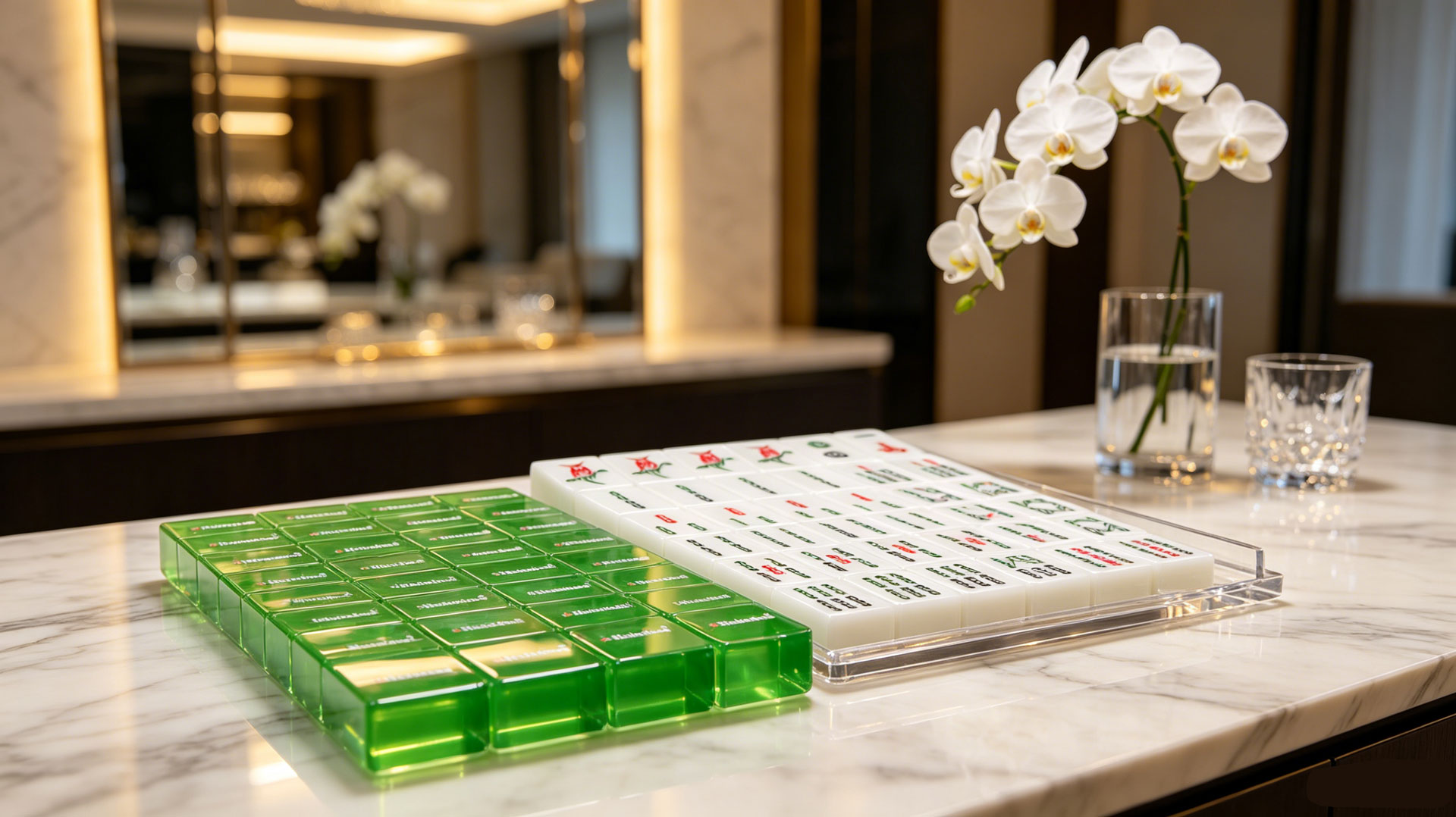
A useful specification sheet identifies what is being ordered and how it will be accepted. Agree each field with the responsible project parties before production. The examples below are procurement prompts, not verified default specifications, official size standards or company capability claims.
Build a configuration sheet
| Field | What to record | What to avoid assuming |
|---|---|---|
| Playing format and contents | The intended rules, every face and quantity, flowers, Jokers and spares | That a 152- or 160-tile label alone establishes complete contents or an official standard |
| Dimensions | Length, width, thickness, corner shape and agreed measurement method | That one size is universal across American mahjong products |
| Materials and finish | Approved material description, layers, surface and edge finish | That a photograph establishes grade, composition or safety |
| Decoration | Process, face and back artwork version, colours and placement | That a screen proof guarantees physical colour |
| Accessories and packaging | Each included item, quantity and the complete packing layout | That racks, dice, mats or boxes are automatically included |
| Acceptance | Reference sample, measurement locations, agreed limits and inspection method | That “premium quality” defines a measurable threshold |
Separate playing rules from retail and legal requirements
Identify the rules your intended customers use and confirm the corresponding tile map. If a buyer specifies NMJL-related play, obtain the applicable current rule or card reference and clarify the required contents with that buyer. No evidence here establishes universal NMJL certification, mandatory US retail approval or automatic shelf-audit failure. Retailer requirements and destination compliance must be checked for the actual channel and product.
Set project-specific acceptance limits
Ask which dimensional variation, artwork placement, colour range and visible surface defects can be measured consistently for the chosen material and method. Agree lighting and instruments where relevant. Record the approved limits in the order and retain representative physical samples. This guide makes no in-house colour-system claim, universal colour-difference threshold or percentage reduction in disputes.
Make commercial assumptions explicit
Request a written quotation with the configuration, quantity, MOQ, sample fees, revision costs and validity period. Request a schedule that separates artwork approval, sample preparation, production, inspection and transit. Clarify calendar or working days and the starting event. Manufacturing arrangements and the party responsible for each stage require project confirmation.
Frequently asked questions
Which tile size is the official American size?
This publication does not establish a universal official size. Select dimensions for the intended users, racks and packaging, then approve a physical sample.
What should accompany an acceptance claim?
Keep the agreed specification, sample reference, batch identifier, inspection result and photographs. Agree reporting periods and remedies before ordering.
Continue with the artwork checklist and sample approval guide, or prepare a customization brief.